
THE DISTRIBUTED HYPERLOCAL MODEL
The neighbourhood
is the warehouse.
INDSTORES connects existing local inventory instead of replacing it with centralised warehouses. Technology becomes the bridge between the customer and the entrepreneur next door.
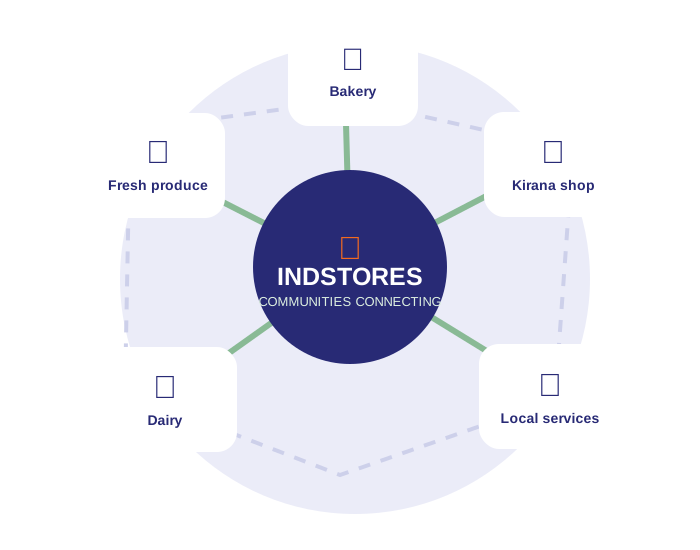
ONE CONNECTED COMMUNITY
Small businesses. Shared infrastructure.
Traditional shops already have products, customers, trust and local knowledge. INDSTORES adds a common digital layer for discovery, ordering, fulfilment and insights.
01 Discover
A shopper searches for products, services or a preferred local store.
02 Connect
The platform surfaces eligible nearby participating merchants.
03 Order
A connected commerce system manages cart, payment and merchant order allocation.
04 Fulfil
Merchant accepts and packs; delivery or customer pickup is coordinated.
05 Settle
Clear transaction records and merchant settlements build confidence.
06 Grow
Customer relationships, repeat ordering and insights strengthen the community.
THE HUMAN DIFFERENCE
The merchant never disappears.
The platform should give customers both “Best Match” and “Choose My Store”. The shopkeeper who has served a family for years can remain their digital shopkeeper.
THREE CONNECTED INTERFACES
A clear digital ecosystem.
The management concept envisages customer, merchant and platform administration experiences, with a delivery partner interface as the network grows.
🙋 Customer experience
Location, discovery, product search, favourite shops, cart and order tracking.
🏬 Merchant workspace
Storefront, catalogue, stock, orders, promotions and settlements.
🧭 Operations & Delivery
Community mapping, order orchestration, partner fulfilment, support and analytics.
THE PUBLIC FEATURE DIRECTORY
20 powerful capabilities. Four connected experiences.
The dedicated homepage grid lists all 20 features from the INDSTORES platform benchmark. The roles below explain how those capabilities serve customers, neighbourhood merchants, delivery partners and administrators.
INDSTORES PLATFORM FEATURE ARCHITECTURE
Every feature has a place in the community.
The proposed ecosystem is built around four role-specific experiences. Each list below is editable directly inside Elementor. Availability depends on commerce platform development, integrations, pilot testing and regulatory readiness.
01
For customers
Find it nearby. Shop with confidence.
- Location / neighbourhood / Community Cell selector
- Stores Near Me with distance and availability
- Category and product / service search
- Deals, freshness, popular picks and favourites
- Store choice: Best Match or Choose My Store
- Product details, seller identity and transparent prices
- One cart with separate merchant sub-orders
- OTP sign-in, saved addresses and order history
- UPI / cards / COD where supported; transparent fees
- Order status, live tracking and delivery choices
- Repeat order, ratings, reviews and support
02
For neighbourhood merchants
Enterprise-grade basics for the smallest shop.
- Digital storefront, photo, location and working hours
- KYC, licence checks and store verification
- Shared master catalogue and local product listings
- Price, stock and offer management
- Inventory: availability, quantity and POS sync stages
- Accept → Pack → Ready → Dispatch workflow
- Customer engagement and preferred store relationships
- Merchant settlements, invoices and payment visibility
- Offers, promotions and neighbourhood marketing
- CRM, loyalty and performance analytics
- Start / Grow / Pro capability tiers
03
For delivery partners
Local fulfilment that respects the locality.
- Merchant delivery, partner delivery and customer pickup
- Community-shared and third-party logistics options
- Partner interest, approval and service-area profiling
- Pickup / drop details and assignment notifications
- Category-sensitive express, priority and scheduled slots
- Order-ready, pickup and delivery confirmations
- Pickup / delivery OTP or QR proof of handover
- Delivery status and customer notifications
- Local delivery routes and travel-time planning
- Delivery fee, fulfilment and payout reporting
04
For platform administrators
Govern the connected local commerce network.
- Neighbourhood Community Cell / geo-node mapping
- Merchant acquisition, approval and KYC workflows
- Store, product and category master management
- Availability + distance + price + trust ranking
- Vendor-aware cart and sub-order allocation
- Commission, subscription and settlement ledgers
- Disputes, refunds, returns, escalation and support
- Deals, sponsored listings and campaign administration
- Fraud safeguards, roles, audits and data governance
- Analytics: merchant activation, order success and GMV
- Pilot performance, rollout and expansion dashboards